Key takeaways
- Market surge: The global AI in film market size is also projected to be USD 14.1 billion by 2033.
- Platform dominance: Midjourney leads with 26.8% market share and 17.5 million Discord users; DALL-E follows at 24.35%
- Business adoption: 51.8% of global influencers now use AI art tools, with architectural firms like Zaha Hadid Architecture integrating AI into early design phases
- Quality concerns: Humans can still distinguish real photos from AI-generated ones, but with a misclassification rate of 38.7%
- Artist impact: 70% of US adults support compensation when AI uses artists’ work in training datasets.
TL;DR
AI art generators have rapidly evolved from experimental tools to billion-dollar industry drivers, with platforms like Midjourney and DALL-E enabling anyone to create sophisticated visuals through text prompts. While businesses are increasingly adopting these tools for marketing, design, and content creation, significant challenges remain around copyright, artist compensation, and the authenticity debate. The technology offers genuine utility but is not without controversy. Most people still do not consider AI output legitimate art, and many professional artists view it as a threat to their livelihood rather than a creative aid.
What exactly is an AI art generator and why should you care?
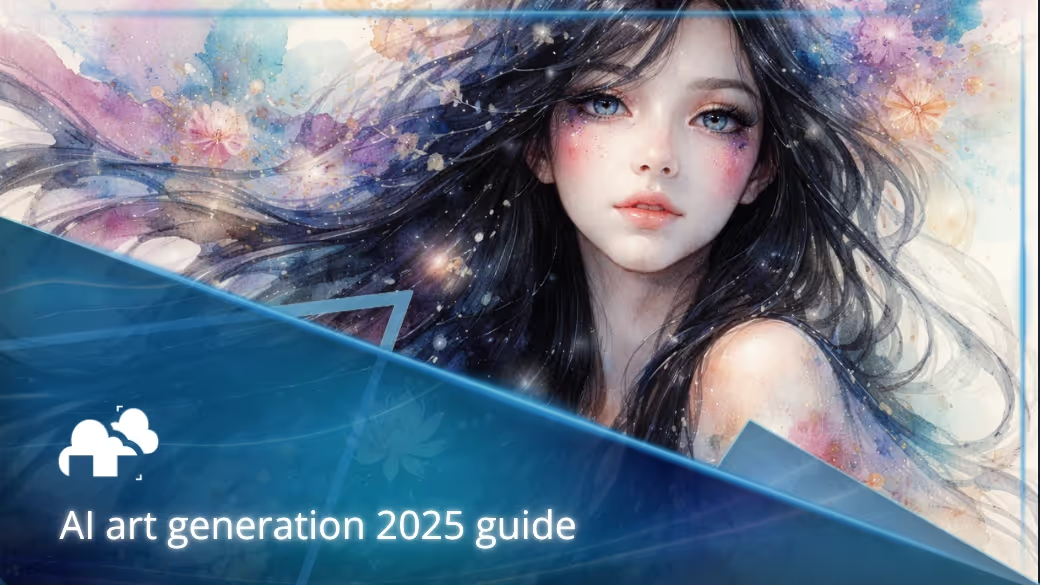
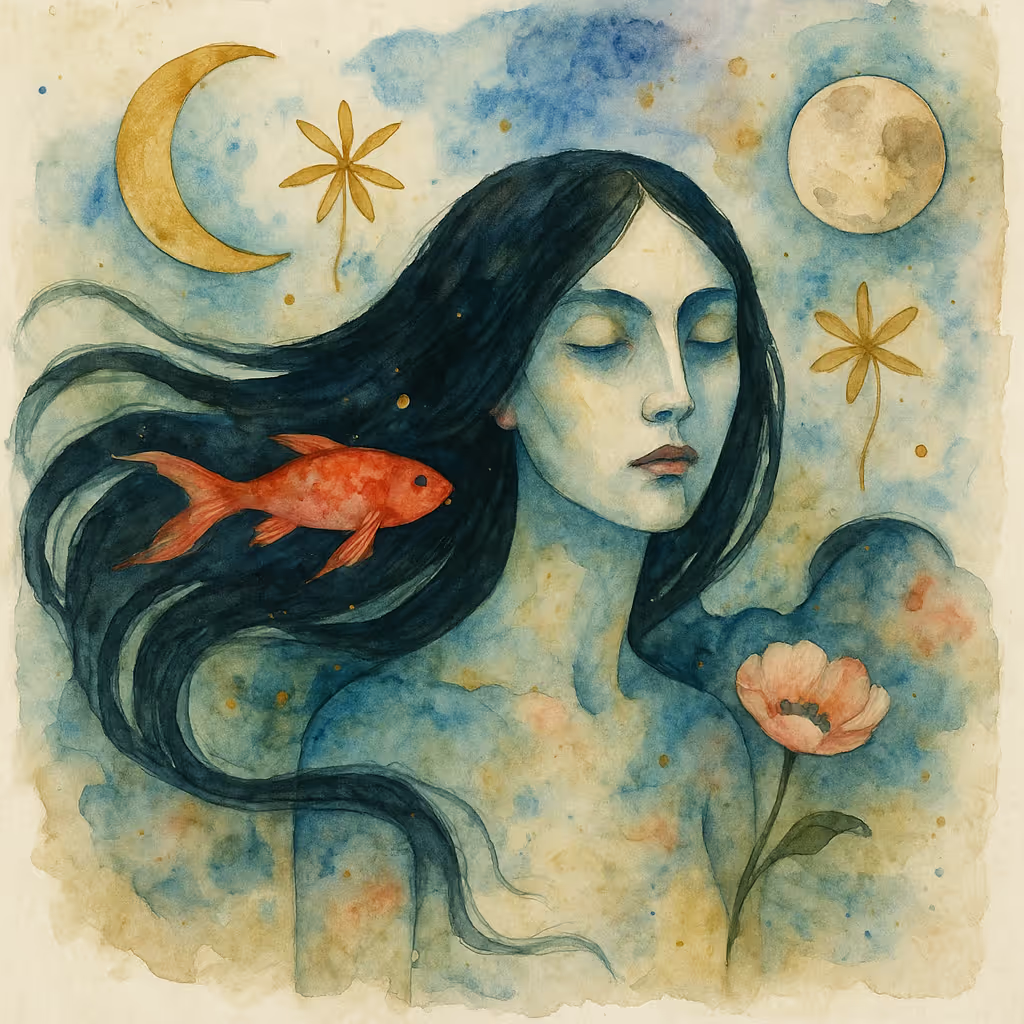
An AI art generator is a tool that allows users to transform simple text prompts into images, or to even input an image (or multiple images) to create an entirely new image. For example, by entering a description such as “a surrealist watercolor painting of a woman with long, black hair” users can receive an image that might have once required hours of painting or digital illustration.
The technology behind the magic
Most AI image generators rely on diffusion models or generative adversarial networks (GANs). In simplified terms, diffusion models start with random noise and gradually “denoise” the image until it aligns with the input description. GANs use a duel between two networks: one generates images, and the other critiques them until the results become convincing. This video by Quick Tutorials also explains the differences between diffusion models and GANs, and how they work:
Running these processes demands significant computational resources. Many AI art platforms such as OpenAI and Stability AI rely on cloud computing and expansive data center infrastructure to deliver results at scale. This makes the technology accessible to anyone with an internet connection, not just those with powerful GPUs.
Market reality check
AI is one of the fastest-expanding sectors in creative technology. According to different sources, it is estimated for AI in the art market to grow to around 40 to 60 billion by the years 2030 - 2033. While hype around generative artificial intelligence is loud, adoption numbers show genuine traction. Both individuals and enterprises are using AI-generated imagery in workflows that range from marketing campaigns to architectural concept development.
Which AI art generator should you actually use in 2025?
Choosing the right tool depends on your budget, goals, and level of comfort with technology. Here is how some platforms compare:
Midjourney
Holding ~26.8% of the market according to AIPRM, Midjourney runs through Discord with subscription tiers from $10 to $120/month. It is known for painterly, atmospheric styles, often leaning toward fantasy landscapes. In tests, it’s fast (usually under a minute per image) but requires time investment in prompt refinement. This video by DiaGraphics shows beginners how to use the text to image generator from Midjourney:
DALL·E 3
Integrated into ChatGPT with ~24.35% market share according to AIRPM, DALL·E 3 offers a free tier and excels at interactive prompt refinement. Its outputs balance photorealism and illustration, making it versatile and beginner-friendly, though less stylized than Midjourney. This introduction by OpenAI shows how DALL·E 3 can be used and its versatility:
Stable Diffusion
Open source and powering billions of images, Stable Diffusion offers maximum control and workflow flexibility. Quality depends heavily on user skill and post-processing, while speed varies by hardware. For businesses, savings on licensing can be offset by hardware costs and labor time. This video by Underfitted explains Stable Diffusion and how the model works:
Gemini / Nano Banana
Launched in 2025 as part of Google’s Gemini ecosystem, Nano Banana (Gemini 2.5 Flash Image) focuses on realism, subject consistency, and creative remixing. It runs fast in Google’s cloud, integrates editing tools like background changes and style transfer, and includes watermarking for provenance. Early adoption shows strong traction in both casual use and professional workflows. Following the recent trend of realistic 3D model images, this video by AsapGuide shows how to use Gemini for just that:
Mobile Apps such as Gleem.ai and Hypic
With mobile phones being extremely popular and accessible today, several mobile apps have already begun integrating AI. Hypic is popular amongst the younger generation by providing AI-powered photo effects such as adding mist to one’s background. Gleem.ai on the other hand excels in creating realistic photos with the help of AI and based on a user’s input, making images for both humans and pets.
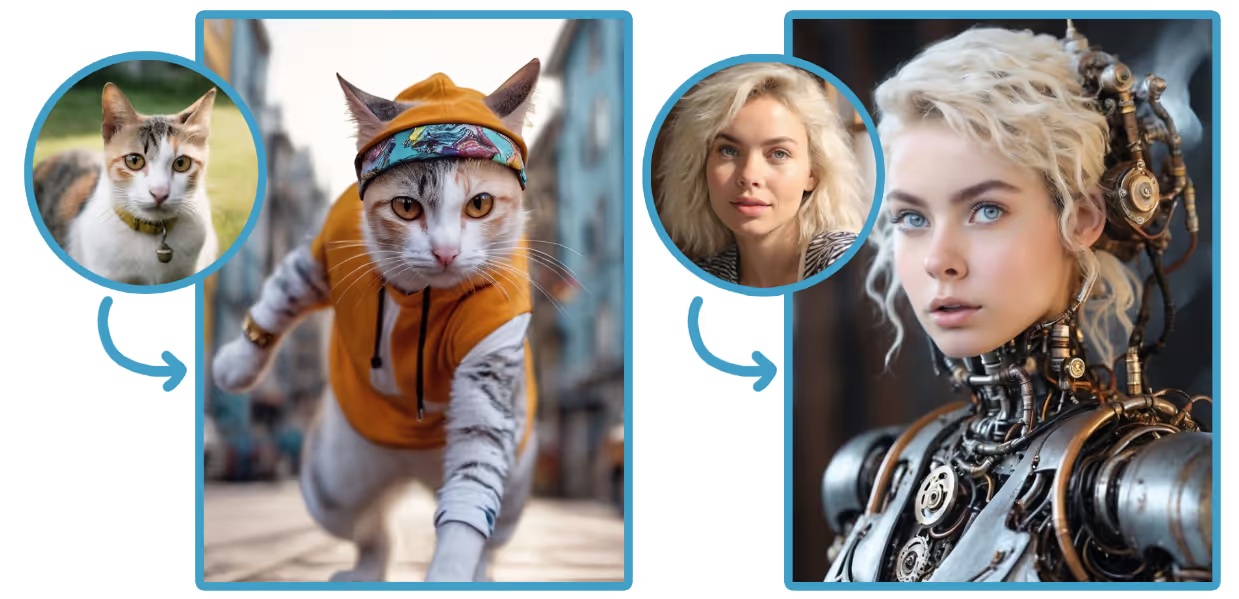
“At Gleem.ai, we believe AI should amplify creativity rather than replace it. Our platform makes professional-quality visuals accessible to everyone, supporting personal expression, social media content, and brand storytelling with a focus on realism and ease of use.” - Gleem.ai
Real-world performance tests
When testing platforms with identical prompts, results vary widely. Midjourney tends toward stylized landscapes, while DALL-E produces balanced outputs across photorealism and illustration. Stable Diffusion provides raw control, though quality depends on user skill in prompt engineering and post-processing in image editing tools.
Processing speed also differs. Midjourney can deliver images in under a minute, while open-source setups may take longer depending on hardware. For businesses, cost per image becomes crucial. Subscription models may be more economical than paying per image, but the hidden cost is the time required to refine and iterate prompts.
How are businesses really using AI art generators?
Real-world example 1: Zaha Hadid Architecture’s design integration
The architectural firm has integrated DALL-E, Midjourney, and Stable Diffusion into early design phases. According to the firm, “Most projects are using it for competitions and early ideation to have a larger repertoire.” This allows architects to explore concepts quickly without extensive manual drafting, expanding their creative process before committing to final forms. In this video by BlessedArch, he interviews Tim Fu from Zaha Hadid Architects and goes into the process of using AI in architecture:
Real-world example 2: The influencer economy shift
According to Art Smart AI, AI is reshaping social media. 51.8% of global influencers now use Canva’s AI image tools, and 36.4% use Photoshop’s AI features. The ability to generate professional-looking backgrounds, anime-style illustrations, or minimalist product shots has reduced costs and sped up production timelines.
Industry adoption patterns
AI-generated art is rapidly being adopted across industries, each finding unique ways to integrate it into their workflows. In marketing, some teams have reported a faster content cycle, creating campaign visuals in days rather than weeks. E-commerce brands are using AI to generate product visualizations, eliminating the need for costly prototypes. In publishing, magazine covers and editorial illustrations are increasingly featuring AI-generated art, highlighting its growing role in mainstream media.
Can AI art generators actually replace human artists?
Photography, painting, and digital design all evolved with new technology, but AI feels like a sharper break.
“[...] AI isn’t just a tool for generating content from scratch—it can also refine, organize, and enhance human ideas. When used thoughtfully, AI can be a powerful assistant, helping streamline communication and save time while preserving the authenticity of the original message.” — Craig Boehman, photographer
The skills vs. automation debate
According to an evaluation by Cornell University (titled HPBench), it was found that humans can still distinguish real photos from AI-generated ones, but with a misclassification rate of 38.7%. This rate can increase as technology advances and while AI models excel at speed, scale, and stylistic mimicry, it can still lack intentionality and emotional resonance. For some artists, this means job displacement. For others, it is a chance to augment workflows, brainstorm ideas, and take imaginations in new directions.
Quality and authenticity concerns
The authenticity debate looms large. A large portion of people, most especially artists, do not consider AI-generated works “true art.” One issue is the uniform aesthetic many generators produce, lacking the subtle imperfections of human expression. While technical quality improves every year, the emotional depth gap remains unresolved.
“For us at Gleem.ai, ethical AI art means balancing innovation with artistry and originality. We focus on making creativity enjoyable and accessible, giving users the freedom to explore their imagination with the convenience of quick, high-quality results, and bridging the gap between technology and human expression.” - Gleem.ai
What are the legal and ethical landmines you need to know?
Copyright complexities
Copyright ownership rules vary across platforms. Midjourney’s terms currently state that users own the images they create (even after canceling), though certain use constraints apply for business users exceeding $1M revenue. While the policy does not clearly state that free-tier users are limited to noncommercial rights, many interpret usage restrictions in lower tiers as such.
In 2025, major lawsuits began to test these boundaries: Disney and Universal sued Midjourney, alleging unauthorized use of their copyrighted content in training data and outputs. Warner Bros. Discovery followed with similar claims of intellectual property theft. These legal actions underscore how unsettled the copyright frontier remains in AI-driven art.
Artist rights and compensation
According to a survey from Book an Artist, 89% of artists are worried that the current copyright law is outdated for AI. It is also showed that 70% of US adults support compensation when AI uses artists’ work in training datasets. Legislative proposals are underway, but until resolved, businesses face uncertainty about using AI-generated art commercially.
How much does it really cost to generate professional-quality AI art?
Platform pricing reality check
Here are some of the pricing checks on popular AI tools:
- Midjourney: Subscription only, $10–120 per month
- DALL-E: Free tier available, with costs starting at $0.040 per image
- Stable Diffusion: Free to use if you host it yourself, though hardware or cloud fees apply
- Gemini / Nano Banana: Gemini 2.5 Flash Image (Nano Banana) is priced such that each image costs about $0.039
- Mobile Apps (e.g. Hypic, Gleem.ai, etc.): Hypic’s subscription fee is at $10.99 per month while Gleem.ai’s subscription is at $24.99 per month.
Hidden costs can include the hours spent on prompt refinement, multiple iteration cycles, and in some cases, purchasing commercial licenses.
ROI analysis for businesses
Compared to hiring illustrators or photographers, AI generation can reduce concept development time from days to minutes. Still, businesses must weigh quality trade-offs. For brand-defining visuals, human artists remain essential. For bulk content and brainstorming, AI generators provide strong ROI.
What problems should you expect when using AI art generators?
Technical limitations and workarounds
AI art generators struggle with prompt interpretation, consistency, and resolution limits. For prompt interpretation, subtle wording differences produce wildly different results. Consistency can also be an issue as replicating a character or style across multiple images remains currently difficult for AI. Lastly, there are still resolution limits thus high-end commercial work may require post-processing in image editing tools. Workarounds to these include better prompt engineering, fine-tuning ratios, and upscaling images with specialized software.
Ethical and social considerations
Bias in AI-generated images remains a major issue, with skewed representation of gender and ethnicity. There are also environmental costs: training large AI models consumes significant energy. On the social side, misinformation fueled by AI-generated visuals raises concerns for marketing, politics, and media.
Where is AI art generation heading by 2030?
According to Fortune Business and Grand View Research, the global AI image market is projected to exceed around $900 million by 2030. This will definitely be a game charger in different industries and could drastically change workflows.
Technology evolution predictions
By 2030, AI art generation is expected to evolve far beyond its current capabilities, with significant technological advancements shaping the way creative content is produced and experienced. We can anticipate seamless integration with AR and VR platforms, allowing for immersive and interactive artistic creation. Real-time video generation will likely expand the field beyond static images, opening up new possibilities in digital storytelling and entertainment. Additionally, improvements in on-device processing are expected to make professional-quality results accessible directly on mobile devices, removing the need for high-end hardware and making advanced AI art tools more widely available. This webinar on AI being integrated in VR is a perfect example of this, showing the use case and its availability:
Industry integration trends
By 2030, AI-generated content is expected to be deeply integrated across multiple industries, transforming both workflows and creative output. In film, although still speculative, some predictions suggest that by 2030, a blockbuster movie might contain up to 90% AI-generated content. According to market.us, the global AI in film market size is also projected to be USD 14.1 billion by 2033. The fashion and retail sectors are likely to continue embracing AI for large-scale customized product visualization, enabling more personalized shopping experiences. Meanwhile, in architecture, AI will accelerate the rapid development of virtual landscapes and conceptual structures, reshaping how designs are visualized and brought to life.
Should you start using AI art generators for your business today?
AI excels at concept development, rapid prototyping, and high-volume content. Human artists remain essential for projects that demand brand authenticity, storytelling, and emotional depth. A hybrid workflow combining human creativity with AI efficiency may offer the best path forward. Start small by experimenting with AI-generated visuals for secondary content. Train teams in prompt engineering to maximize output quality. Finally, ensure compliance with copyright and licensing rules before commercial deployment.
Register Now and Get $50 FREE Credits!