


An Animated Music Video for Emicida - Directed by Pedro Conti and Diego Maia
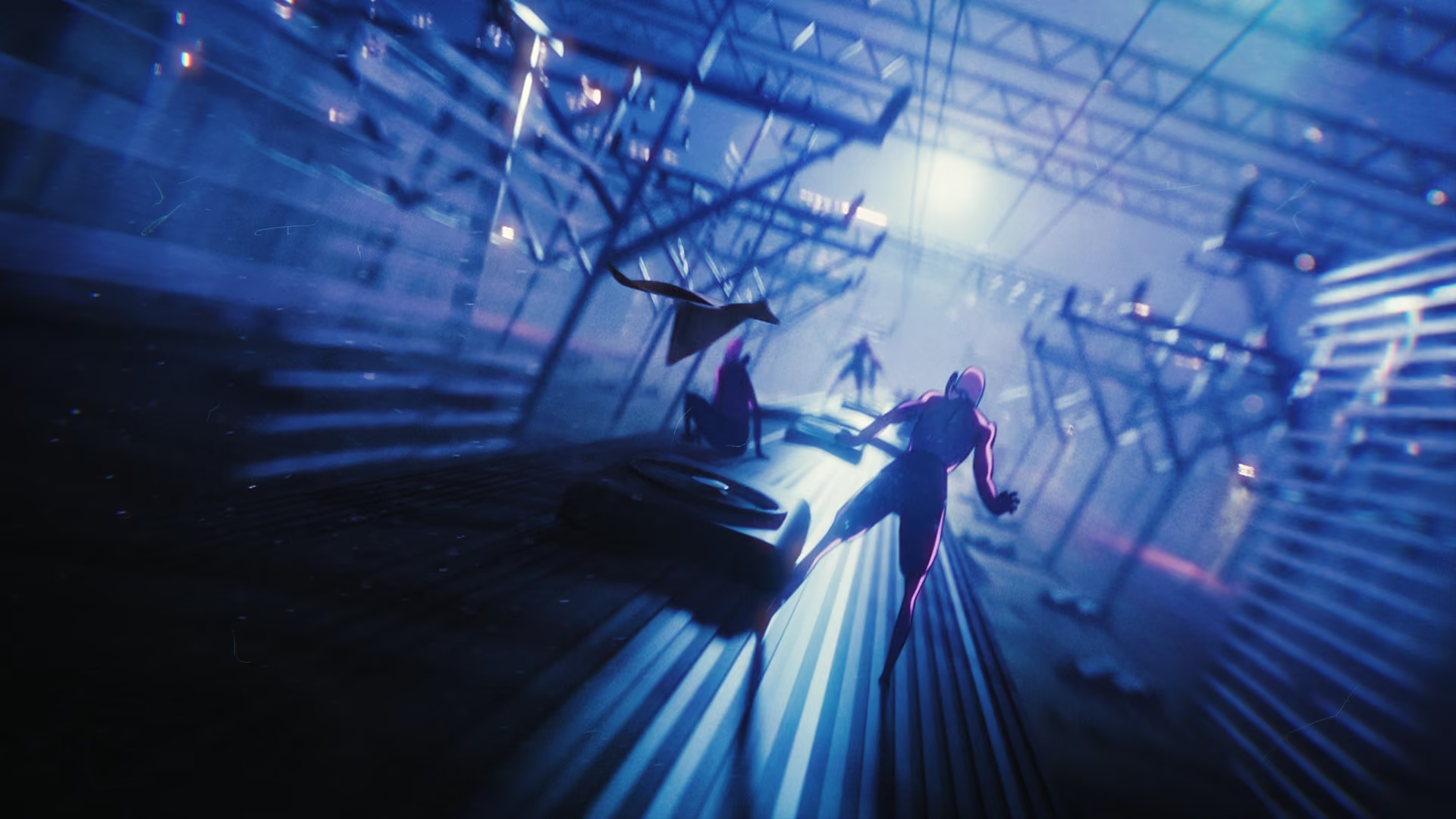
Brazilian animator and director, Pedro Conti invites us into a deeply personal and visually layered celebration of Brazilian life through his latest project: a music video for Emicida's "Quanto Vale o Show memo?!", created in close collaboration with longtime friends Diego Maia and Emicida himself. Rendered with the help of GarageFarm.NET, the project weaves together memory, cultural identity, and raw emotion across more than multiple scenes.
The video is a journey through Brazil between 1988 and 2003, told not as a history lesson but as a collection of fragments. For Pedro, the work was never about technique, but about truth.
"Making art isn't really a choice — it's my way of processing and navigating life. It started as a lifestyle and eventually became my work."
Creative beginnings from music to art
Pedro's path to animation began long before he ever touched a 3D software. As a child in Brazil, music was his first creative language. He moved from flute to trumpet, then to acoustic guitar, and eventually to electric guitar, finding in each instrument a new way to connect with himself in a meaningful way. It was only in high school, through two friends who introduced him to drawing, that a new door opened that led him to 3D animation in 2005.

Today, Pedro's inspiration comes from the everyday: people, architecture, and the routines that quietly define a life. His art is a record of those observations, processed and given form.
A music video built from memory and a hybrid pipeline
"Quanto Vale o Show memo?!" is a film about growing up in Brazil, and about the specific textures of a time and place that shaped a generation. The collaboration between Pedro, Diego Maia, and Emicida was made possible by years of friendship and the kind of honesty that only comes with trust.
"The collaboration between Emicida, Diego Maia, and me, longtime friends, allowed us to be honest about the things we've lived through in our lives. Because of that, all the decisions came naturally, rooted in our personal experiences."
The narrative was assembled from fragments of memory, mirroring the structure of the song itself. As those fragments connected, they began to form a script. The team committed early to pushing the visuals to genuinely represent their culture and their reality. Not an idealized version of Brazil, but the one they actually knew.
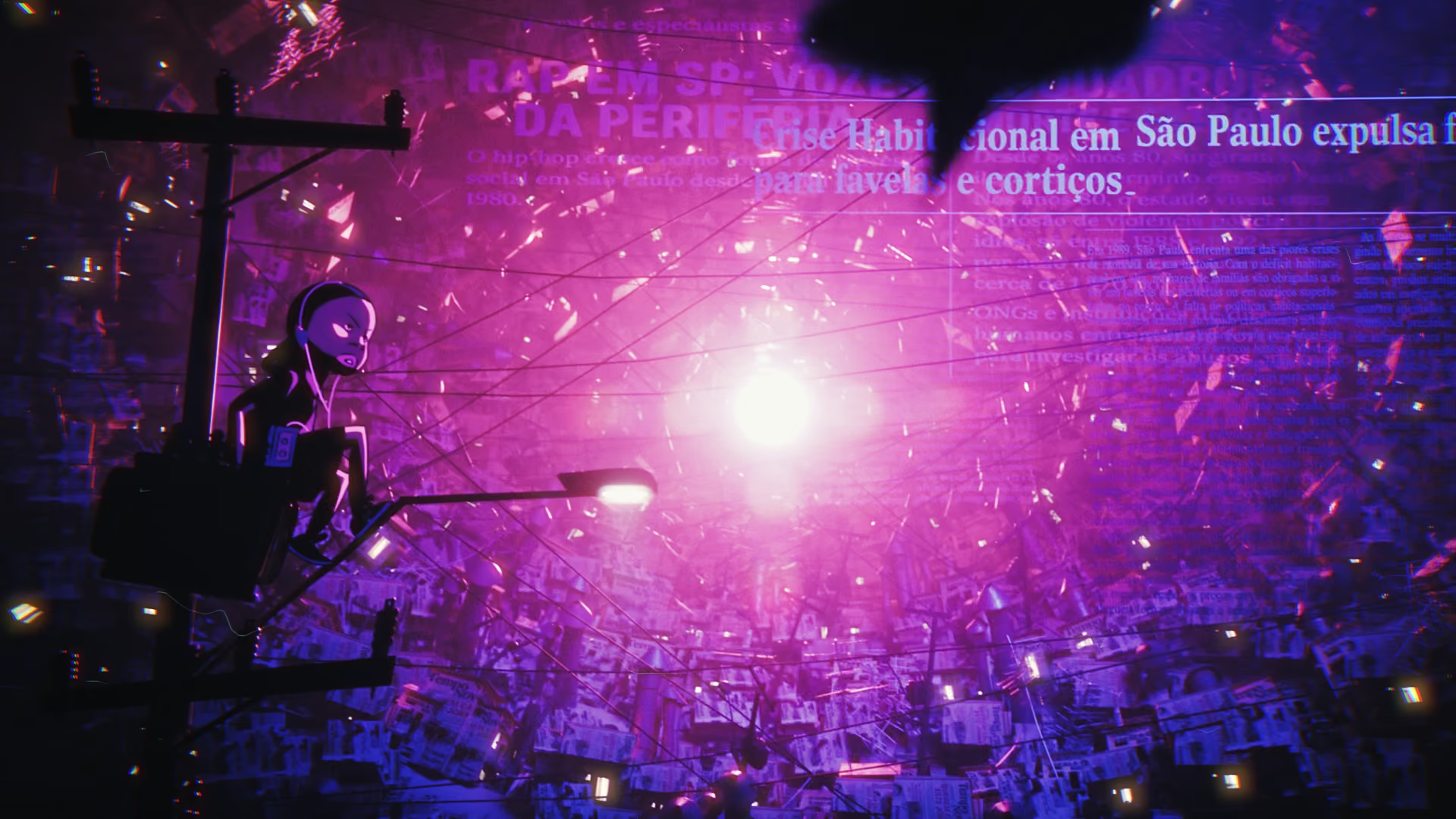
One of the most striking examples of that commitment came when Pedro revisited a site in São Paulo connected to a prison shooting from the 1990s that appears in the film. He had grown up near that location. The prison no longer stands, replaced now by a park, though remnants of its walls remain.

"I visited the location to reconnect with the atmosphere. I remember the overwhelming scale of the walls and how small they made people feel. So everything we added to the film was grounded in reality."
The team used a hybrid pipeline: Blender for 2D animation and 3ds Max for fully built 3D environments, with V-Ray handling rendering. Compositing was done in After Effects and the final edit in Premiere. Rather than building everything in 3D from the ground up , Pedro and his collaborators deliberately simplified the workflow to keep the focus on storytelling.
The challenge of visualizing a journey

The greatest creative challenge wasn't a technical one, it was editorial. With more than 35 scenes, Pedro and his team had to find a way to make the camera feel like a character, and the timeline feel like a journey.
"We wanted the audience to feel like they were traveling through time, revisiting memories along the way."
Significant historical research was required to ensure the details held up. The scale of individual scenes also evolved during production. What began as an approach modeled after stop-motion maquettes, gradually gave way to something much larger, as it became clear that the environments needed room to breathe emotionally. Scale, in the end, became something discovered rather than planned.
Rendering at the speed of creative thought
Pedro's design process is fundamentally cinematic. He doesn't think in terms of individual assets, he thinks in scenes, camera movement, spatial relationships and light. That means rendering isn't just a final step; it's intertwined into the entire creative process. And because of this, Pedro creates multiple low-resolution renders for an entire sequence to better understand how each element interacts with one another.
"The ability to block a scene, set up quick lighting, and send it to the render farm to evaluate the result is a crucial part of my design process. That first pass informs new decisions, and I keep refining from there until the visuals are locked."
While looking for ways to render more efficiently, a recommendation from a friend pointed him toward GarageFarm.NET, which he tested on smaller projects first. By the time "Quanto Vale o Show memo?!" entered production, the pipeline was already proven and tested.

The results were decisive. Completing the project on a local workstation would have been, in Pedro's own words, simply impossible. The number of scenes and frames far exceeded what any single local machine could handle. With GarageFarm handling the heavy lifting, Pedro was free to iterate quickly, push through multiple versions of scenes, and make creative decisions without waiting days between renders.
"Collaborating with GarageFarm supported that workflow really well. I was able to iterate quickly and go through multiple versions while making creative decisions."
The support team of GarageFarm also played a role with responsiveness and was quick to resolve the minor issues in the project. The overall experience, Pedro notes, felt seamless and efficient.
Looking ahead: new styles, short films and exhibitions
His next chapter is a full one. Pedro is excited to push for new art styles and already has several short films written, in which he is working through the production process for each. He is also planning an animation exhibition in Brazil, bringing together the independent projects he has directed over the past several years. This would be a way of making that work visible and, more importantly, inspiring young Brazilian artists to pursue their own path in animation.
Furthermore, Pedro sees render farms as both a convenience and a creative necessity for how 3D artists can work.
"Using a render farm unlocks the creative process as a 3D artist. It allows you to express ideas quickly without getting stuck in technical limitations or waiting days to see just a few seconds rendered. At this point, the render farm is an essential part of my creative workflow. I honestly can't imagine making films without it."
In conclusion, the camera, for Pedro Conti, is always moving. There are more scenes to build, more memories to animate, and more of Brazil yet to put on screen.
–
Like Pedro’s and Diego Maia's work? To see more, visit:
Pedro Conti (Website): https://www.pedroconti.com/
Pedro Conti (Instagram): https://www.instagram.com/pedrodtconti
Diego Maia (Instagram): https://www.instagram.com/miragemmaia/