


Key takeaways
- Real time rendering prioritizes speed and interactivity, while offline rendering focuses on final image quality.
- Hybrid rendering combines techniques such as rasterization and ray tracing to balance performance and visual quality.
- The global 3D rendering market was valued at $4.5 billion in 2025 and is projected to reach $5.7 billion in 2026 (GrandViewResearch).
- Modern rendering engines can support multiple rendering approaches within the same production workflow.
- Choosing the right approach depends on project requirements, hardware resources, visual quality, and production deadlines.
TL;DR
Real time, hybrid, and offline rendering are different approaches to creating computer graphics. Real time rendering produces images quickly enough for interactive experiences, while offline rendering allows more processing time to achieve detailed lighting, materials, and visual effects. Hybrid rendering combines techniques such as rasterization and ray tracing to improve visual quality while maintaining performance. Each approach has its advantages, and many modern 3D workflows use a combination of them, as well as render farms, to balance creative flexibility, rendering speed, and final image quality.
Introduction
Rendering is one of the most important stages of 3D production, transforming digital scenes into the images and animations audiences eventually see. Whether an artist is building a video game environment, producing an animated film, or creating an architectural walkthrough, the rendering process determines how geometry, lighting, materials, and effects appear on screen.
As 3D projects become more complex, rendering technologies continue to evolve. The global 3D rendering market was valued at $4.5 billion in 2025 and is projected to reach $5.7 billion in 2026 (GrandViewResearch), reflecting the growing demand for visualization across industries. Today, artists can choose between real time, hybrid, and offline rendering, each offering different levels of responsiveness, visual accuracy, and computational requirements.
What is real time rendering?
Real time rendering generates images quickly enough for users to interact with a digital environment without noticeable delays. Unlike traditional rendering, where each frame may take considerable time to calculate, real time engines continuously update the image as the camera moves, objects change, or lighting conditions are adjusted. This approach is commonly associated with video games, but it is also widely used in architectural visualization, virtual production, product design, and interactive experiences.
How real time rendering works
Real time rendering traditionally relies heavily on rasterization, a technique that projects 3D geometry onto a 2D image and determines which surfaces are visible. Lighting, shadows, reflections, and other effects are then calculated using optimized methods designed to minimize processing time.
Modern engines such as Unreal Engine and Unity can also incorporate ray tracing, advanced lighting systems, and image reconstruction to produce more realistic results. However, these features must operate within a limited time budget for each frame, so developers often make compromises between image quality and responsiveness.
Advantages and limitations
The biggest advantage of real time rendering is immediate visual feedback. Artists can adjust materials, move cameras, and experiment with lighting while seeing the results almost instantly. This makes creative iteration much faster, particularly when multiple people need to review a scene.
The main limitation is performance. Complex geometry, realistic reflections, detailed shadows, and demanding visual effects can reduce frame rates. Maintaining smooth interaction may require simplifying certain calculations, optimizing assets, or using techniques that approximate more expensive lighting effects.
What is offline rendering?
Offline rendering generates images without needing to maintain an interactive frame rate. Instead of completing every frame within a fraction of a second, the renderer can dedicate additional time to calculating light interactions, materials, shadows, and complex visual effects. This approach is widely used in animated films, visual effects, architectural visualization, and advertising, where the final image can be more important than immediate responsiveness. Popular offline renderers include Blender Cycles, Arnold, V Ray, Corona, and Redshift.
How offline rendering works
Many offline renderers use ray tracing or path tracing to simulate how light travels through a scene. Rays interact with surfaces, reflect or refract through materials, and contribute to the final appearance of each pixel.
The renderer typically calculates multiple samples to improve lighting accuracy and reduce noise. More complex scenes, higher resolutions, and demanding materials may require additional samples and processing time. Depending on the software, rendering can be performed using CPUs, GPUs, or a combination of available computing resources.
Advantages and limitations
Offline rendering gives artists greater flexibility when working with detailed lighting, complex materials, realistic reflections, and physically based effects. Since the output does not need to respond immediately to user interactions, the renderer can spend more time calculating each frame.
The tradeoff is rendering time. A detailed scene may take minutes or longer per frame, which becomes especially demanding for animations containing thousands of frames. This is where render farms can be useful, allowing frames to be distributed across multiple machines instead of relying entirely on a local workstation.
What is hybrid rendering?
Hybrid rendering combines different rendering techniques within the same pipeline to balance image quality and computational performance. One common example is combining traditional rasterization with ray tracing, allowing an engine to calculate some effects more accurately without relying entirely on expensive ray tracing calculations. Hybrid rendering is often used within real time engines, so it should not be considered a completely separate category from real time rendering. Instead, it describes how different rendering techniques work together to produce the final image.
How hybrid rendering combines techniques
Rasterization efficiently determines which objects and surfaces are visible, while ray tracing can be used selectively for effects such as reflections, shadows, or indirect lighting. This allows the engine to dedicate more processing power to areas where ray tracing provides a noticeable visual improvement. Because ray tracing can introduce noise when using fewer samples, hybrid pipelines may also rely on denoising and temporal reconstruction to produce cleaner images. Unreal Engine, for example, supports hybrid ray tracing techniques that combine traditional rasterization with more advanced lighting calculations.
Advantages and limitations
Hybrid rendering offers a useful compromise between performance and realism. Artists can benefit from more convincing lighting and reflections while retaining much of the responsiveness associated with real time rendering. However, these systems can be more complicated to configure and optimize. Ray tracing still requires processing power, and differences between rasterized and ray traced effects can occasionally produce visual inconsistencies. The results depend heavily on the engine, hardware, and rendering settings being used.
Real time vs. hybrid vs. offline rendering: Key differences
Although all three approaches generate images from 3D scenes, they differ in how they distribute computational resources and prioritize performance. Understanding these differences makes it easier to select a rendering method based on the project's requirements.
These categories can overlap. A real time engine may already use hybrid rendering, while an offline renderer can provide interactive previews at reduced quality. The differences become more apparent when considering how each method is used during production.
How different rendering methods fit into 3D production
A single project can benefit from multiple rendering approaches at different stages. Artists may need quick previews while developing a scene, more accurate lighting while refining it, and detailed final frames when delivering the finished project.
Real time rendering for previews and development - During early production, artists frequently adjust models, camera positions, materials, and lighting. Real time rendering makes these changes easier to evaluate because the image updates immediately. This is particularly useful for animation blocking, environment design, and virtual production, where waiting for final quality renders would interrupt the creative process.
Hybrid rendering for interactive visualization - Hybrid rendering becomes useful when a project requires both interactivity and convincing visual effects. Architectural walkthroughs, for example, can use rasterization for efficient scene rendering while applying ray tracing to reflections or lighting. This allows clients to navigate a digital environment while seeing more realistic materials and illumination.
Offline rendering for final production - Once a 3D scene is ready, offline rendering provides the visual accuracy needed for final delivery. Renderers such as Blender Cycles, V Ray, and Redshift allow artists to produce detailed lighting, realistic materials, and complex visual effects. This makes offline rendering particularly useful for animated films, architectural visualization, product renders, and VFX projects where image quality is a priority.
For animation projects, rendering every frame at final quality can require substantial computing resources. Artists may use a cloud render farm to distribute the workload across multiple machines, reducing the time needed to complete an image sequence without compromising their chosen quality settings.
How different rendering approaches work in real productions
Real time and offline rendering offer different advantages depending on the production. Some studios prioritize interactive visualization, while others rely on detailed lighting and materials to create realistic images. The experiences of RDVIS and Ray Wakui demonstrate how artists choose rendering techniques based on their creative requirements.
RDVIS: Combining offline rendering with interactive experiences
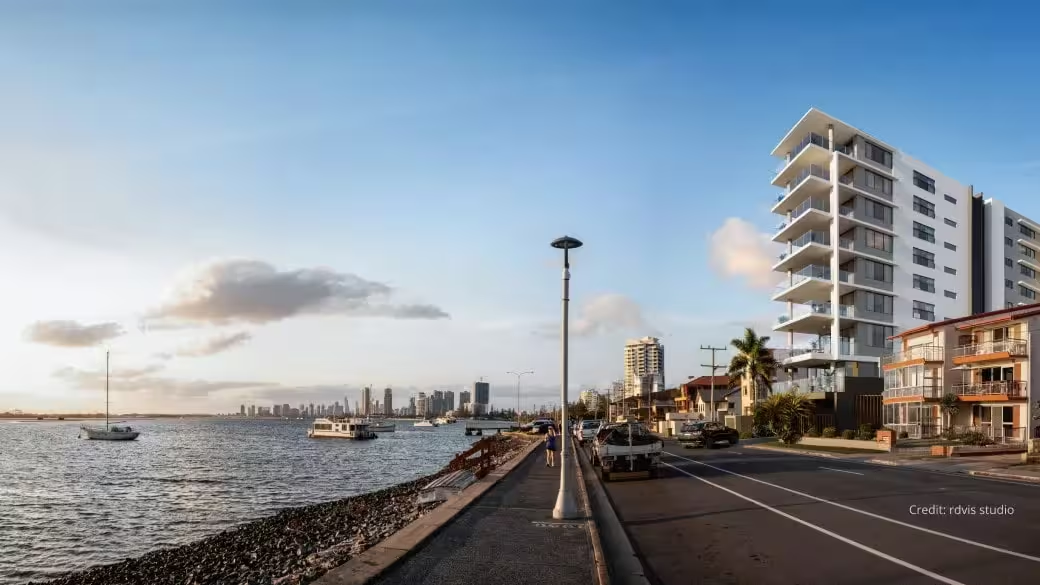
In a case study, architectural visualization studio RDVIS creates photorealistic images, animations, and virtual property tours using 3ds Max and Corona. Through its ArchviewVR platform, users can explore architectural environments interactively using panoramas rendered in advance. This approach combines the visual quality of offline rendering with the convenience of interactive navigation.
"I moved into the urban planning and civil construction planning space utilizing real-time gaming technology to explore and design spaces for government and public projects. " - Robert, RDVIS
Ray Wakui: Using offline rendering for realistic visual effects
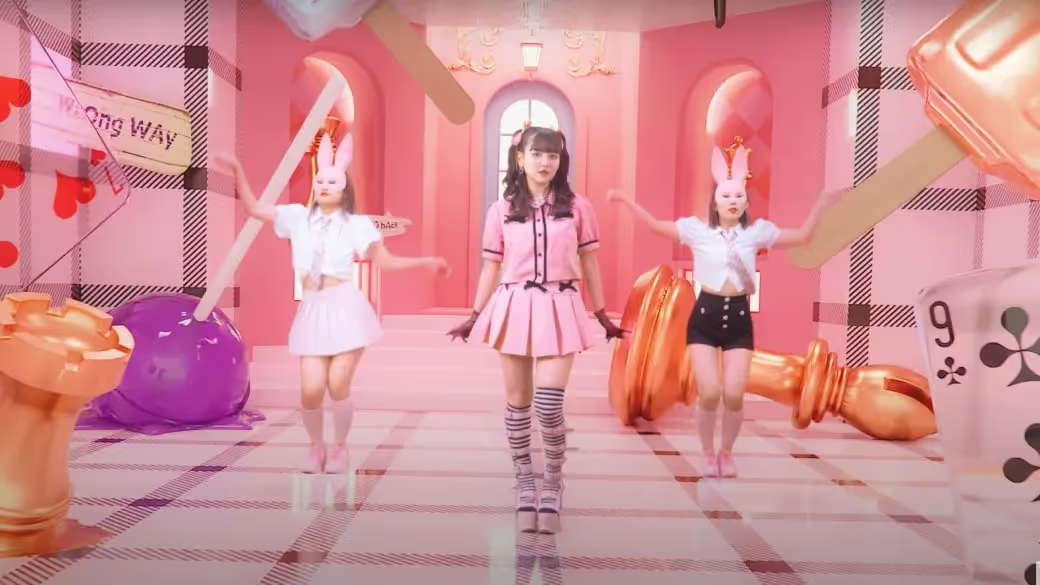
In another case study, VFX artist Ray Wakui uses Blender Cycles to create realistic CG environments and effects for music videos. For Noah Sato's LADYBUG, he rendered 343 frames across four visual effects sequences using GarageFarm.NET. The project involved combining CG elements with live action footage, requiring careful attention to lighting, reflections, and materials.
Ray's approach emphasizes the importance of realism in offline rendering, particularly when digital environments need to blend convincingly with filmed footage.
"I'm attracted to CG that has a realistic atmosphere, texture, and smell, so I'd like to see more CG content that pursues the ultimate in realism, unlike real-time CG or the metaverse…" - Ray Wakui
These examples demonstrate how different rendering approaches support different production needs. RDVIS uses offline rendering to create detailed environments that can still be explored interactively, while Ray Wakui prioritizes realistic lighting and materials for cinematic visual effects.
How to choose the right rendering approach
The most suitable rendering method depends on what the project needs to accomplish. Rather than choosing based on visual quality alone, artists should consider how the final output will be experienced and how much time and processing power are available. A few important factors include:
- Project type: Interactive games and virtual experiences generally benefit from real time rendering, while prerecorded animation and high quality still images may benefit from offline rendering.
- Visual requirements: Complex reflections, realistic materials, and demanding lighting effects can influence which techniques are necessary.
- Hardware resources: CPU performance, GPU capabilities, and available memory affect rendering speed and scene complexity.
- Production deadlines: Short deadlines may require faster preview workflows, reduced rendering complexity, or access to additional computing resources.
- Budget: Local rendering may be sufficient for smaller projects, while cloud rendering can provide additional capacity when needed.
Testing a representative scene is usually the most reliable way to compare different approaches. A short render test can reveal performance bottlenecks, visual differences, and potential problems before they affect the entire production.
The future of real time, hybrid, and offline rendering
Rendering technology continues to evolve as graphics hardware and software become more capable. Improvements in GPU performance, ray tracing, and intelligent image reconstruction are allowing real time applications to produce increasingly sophisticated lighting and visual effects. AI assisted denoising and upscaling also help reduce the computational cost of generating detailed images. Meanwhile, offline renderers could continue to improve their performance, giving artists faster previews and more efficient final rendering.
These developments are also encouraging closer integration between rendering approaches. Artists can increasingly move between interactive previews and final quality rendering within the same production environment, making it easier to maintain visual consistency throughout a project.
Frequently asked questions
- Is real time rendering better than offline rendering? Neither approach is universally better. Real time rendering is generally more suitable for interactive experiences, while offline rendering offers greater flexibility for computationally demanding visual effects and final quality images.
- Is hybrid rendering the same as ray tracing? No. Ray tracing is a rendering technique that simulates light interactions, while hybrid rendering combines multiple techniques, often including rasterization and ray tracing.
- Can real time rendering achieve photorealistic results? Yes. Modern engines can produce highly realistic images, although maintaining smooth performance may require compromises in scene complexity or rendering accuracy.
- Why does offline rendering take longer? Offline rendering can spend more time calculating lighting, reflections, materials, and multiple samples per pixel. Complex scenes and higher quality settings generally increase rendering time.
- Can Unreal Engine be used for offline rendering? Yes. Unreal Engine includes a Path Tracer that can produce high quality images and animations without the performance constraints associated with interactive rendering.
- Do you need a render farm for offline rendering? Not necessarily. Smaller projects can often be rendered locally, but a render farm can help distribute demanding workloads across multiple machines when local resources or deadlines become limiting.
Conclusion
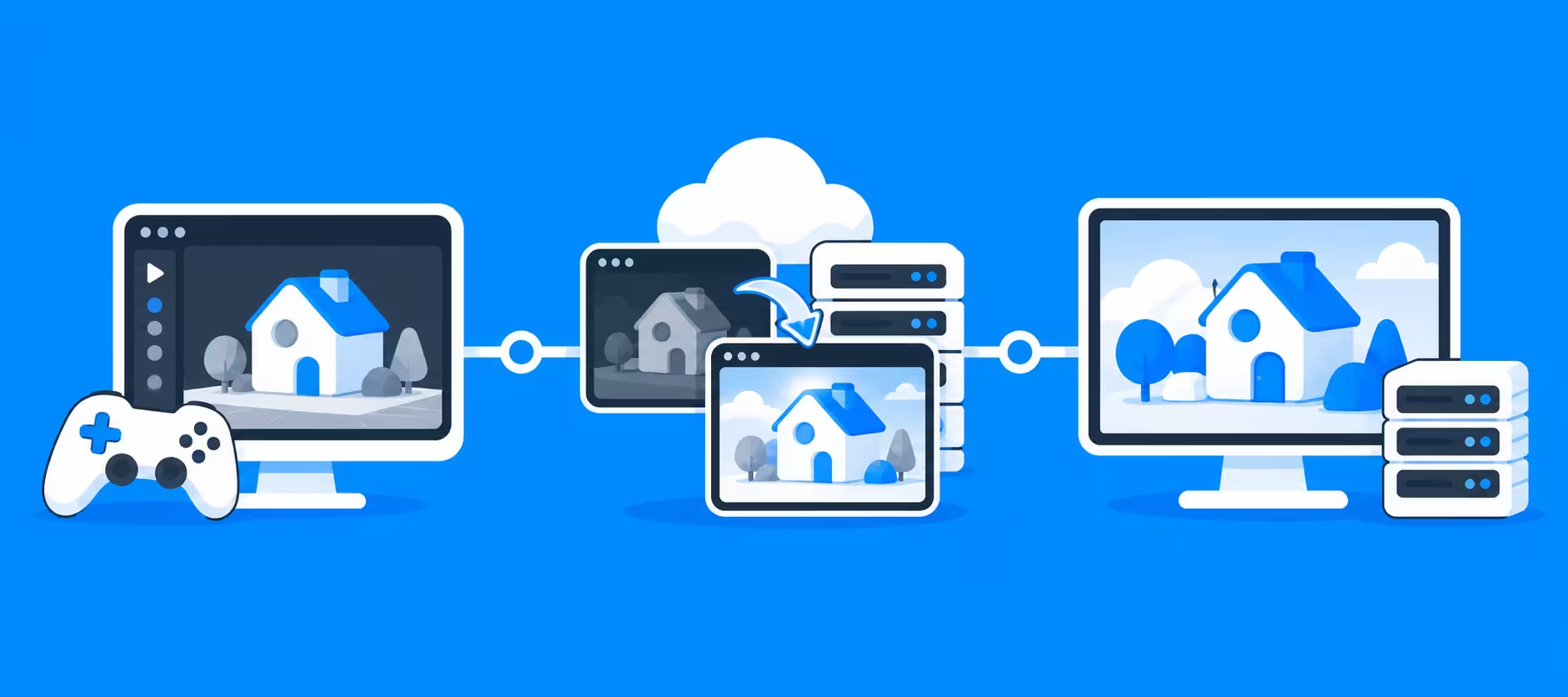
Real time, hybrid, and offline rendering each serve different production needs. Real time rendering enables immediate interaction, hybrid techniques improve visual quality while managing performance, and offline rendering provides the flexibility to produce detailed final images.
Modern 3D workflows can take advantage of all three approaches, using fast previews during development and more computationally demanding techniques when greater visual accuracy is needed. By understanding how these methods work and where they perform best, artists and studios can build rendering workflows that support both their creative goals and production requirements.
Register Now and Get $50 FREE Credits!