Key takeaways
- Gaussian splatting is a strong choice when visual realism, smooth novel views, and interactive rendering matter most.
- Photogrammetry is usually better when you need measurable surfaces, textured meshes, or assets for traditional 3D workflows.
- The global 3D reconstruction technology market was estimated at about $1.70 billion in 2025 and $1.91 billion in 2026 (360iResearch).
- Both methods can begin with similar image capture, but they create fundamentally different types of 3D representations.
TL;DR
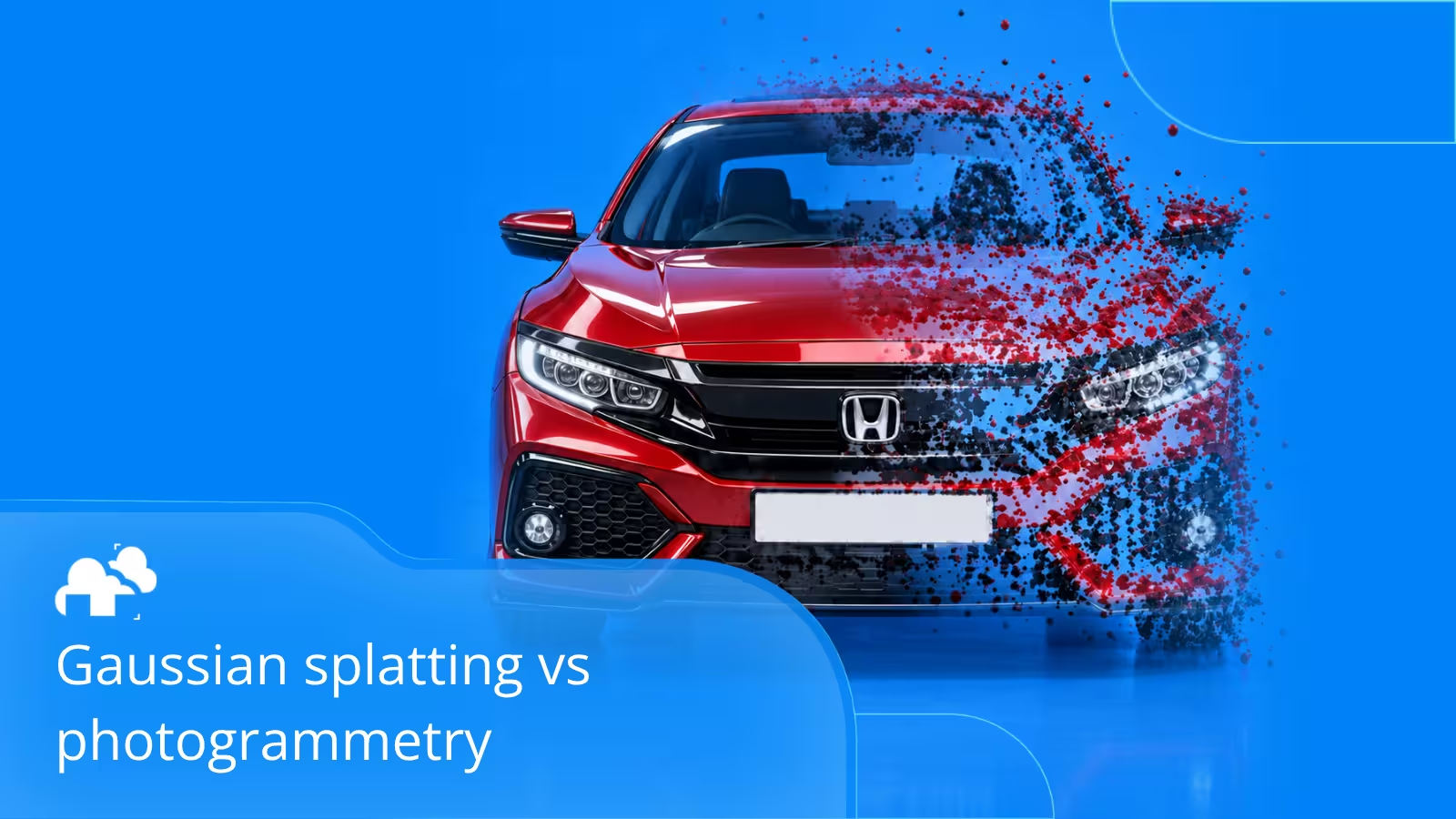
Gaussian splatting and photogrammetry can both reconstruct real scenes from overlapping images, but they serve different goals. Gaussian splatting creates a radiance based representation that is especially good at producing realistic new viewpoints and smooth interactive rendering. Photogrammetry focuses more directly on recovering surface geometry and commonly produces point clouds, meshes, and textures that fit conventional 3D workflows. For virtual backdrops, immersive scenes, and rapid visual capture, Gaussian splatting can be the better fit. For measurement, surveying, asset creation, collision geometry, or workflows that need an editable mesh, photogrammetry is usually more practical.
Why Gaussian splatting vs photogrammetry matters
Both methods can start with a camera moving around an object or environment and capturing overlapping views. The difference becomes clearer after the camera positions are solved. Photogrammetry continues toward explicit surface reconstruction, while Gaussian splatting optimizes a collection of Gaussian primitives to reproduce how the scene appears from different viewpoints.
Interest in these workflows is growing alongside the wider 3D reconstruction field as well. The global 3D reconstruction technology market was estimated at about $1.70 billion in 2025 and $1.91 billion in 2026 (360iResearch), reflecting broader demand for technologies that turn real spaces and objects into digital representations.
What is 3D Gaussian splatting?
3D Gaussian splatting represents a scene using many small three dimensional Gaussian primitives. Each Gaussian stores information such as position, scale, orientation, opacity, and appearance. During optimization, those Gaussians are adjusted until rendered views closely match the source images. Because the representation is explicit and can be rasterized efficiently on a GPU, it can support very fast rendering once the scene is trained.
What is photogrammetry?
Photogrammetry reconstructs three dimensional structure by finding matching visual features across overlapping photographs. A common pipeline estimates camera positions through Structure from Motion, creates a sparse reconstruction, builds denser geometry through Multi View Stereo, and then generates a point cloud, mesh, and texture.
That surface focused output is one of photogrammetry's biggest advantages. The geometry can be cleaned, retopologized, measured, textured, used for collision, or exported into familiar 3D applications.
The biggest differences between Gaussian splatting and photogrammetry
How a Gaussian splatting workflow works
A typical gaussian splatting workflow starts with overlapping photographs or frames extracted from video. Camera poses are estimated, often with Structure from Motion software. A sparse set of points can provide the initial structure, after which the system optimizes the Gaussians so rendered views match the training images.
Once optimized, the finished scene can be opened in a compatible splat viewer or renderer. Depending on the project, the data can also be processed further when geometry or integration with another 3D pipeline is required.
How a photogrammetry workflow works
A photogrammetry workflow also begins with overlapping image coverage. The software detects and matches features, solves camera positions, builds a sparse point cloud, estimates denser depth information, and converts that data into a dense point cloud or polygon mesh.
Textures can then be projected from the original photographs. Artists may continue with cleanup, retopology, UV work, simplification, and texture baking if the scan is becoming a production asset.
Gaussian splatting vs NeRF
The gaussian splatting vs nerf comparison is slightly different from comparing Gaussian splatting with photogrammetry because both methods are designed for novel view synthesis. A NeRF represents a scene implicitly through a neural network that maps spatial position and viewing direction to volume density and view dependent radiance. 3D Gaussian splatting instead represents the scene explicitly using a collection of three dimensional Gaussian primitives that are projected and blended during rendering.
In a nerf vs gaussian splatting comparison, Gaussian splatting is particularly attractive because it can provide fast interactive rendering while maintaining strong visual quality. NeRF methods can still suit specific research and reconstruction workflows, but neither approach automatically provides the clean polygon topology expected from conventional 3D asset creation.
When Gaussian splatting makes more sense
Gaussian splatting is especially useful for virtual production backdrops, immersive scene capture, films, virtual tours, environment reference, and other projects where a location needs to look convincing from many nearby viewpoints. Its ability to preserve complex visual appearance makes it particularly useful when the final result is primarily meant to be viewed rather than heavily remodeled.
It can also shorten the path from capture to interactive visualization. If a team mainly needs to explore or present a location rather than immediately turn it into a polished polygon asset, the Gaussian representation can reduce some of the mesh cleanup normally associated with photogrammetry.
When photogrammetry makes more sense
Photogrammetry remains practical when a captured object or environment needs to become a conventional 3D asset. A mesh can be retopologized, UV mapped, baked, combined with other geometry, used for collision, or passed through standard modeling and texturing tools. This makes it a natural choice for many game, VFX, architecture, product, and cultural heritage workflows.
Can Gaussian splatting and photogrammetry work together?
Yes. The two methods can share parts of the same capture and camera solving process. A team might use photogrammetry to create dependable geometry while using Gaussian splatting to preserve richer scene appearance for visualization.
Another workflow might begin with a splat for rapid scene review, then create or extract geometry only where editing, collision, compositing, or simulation requires it. Using both can be practical when neither visual appearance nor usable geometry can be sacrificed.
Final thoughts
Gaussian splatting has expanded what image based 3D capture can achieve when realism and interactive rendering are the main goals. Photogrammetry remains highly relevant because usable surface geometry is still essential across mapping, VFX, games, architecture, cultural heritage, and many other fields. Gaussian splatting focuses heavily on reproducing how a scene looks, while photogrammetry focuses more on reconstructing the surfaces that make up the scene. Understanding that distinction makes it much easier to choose the right approach for a project.
Register Now and Get $50 FREE Credits!